Chronicles of a Social Media Breaker
As discussed in my previous post, I recently deleted WhatsApp. And of course, a few friends—fully aware of how dramatic I can be—started calling like, “Daphney, can you stop fighting with that man already and come back online?” But plot twist— They were wrong this time. (Or were they? That’s for me to know and for you to keep speculating.)
What I can tell you is this: my relationship with WhatsApp has always been… complicated. And with every new feature they roll out, it somehow gets worse. Case in point? Group chats.
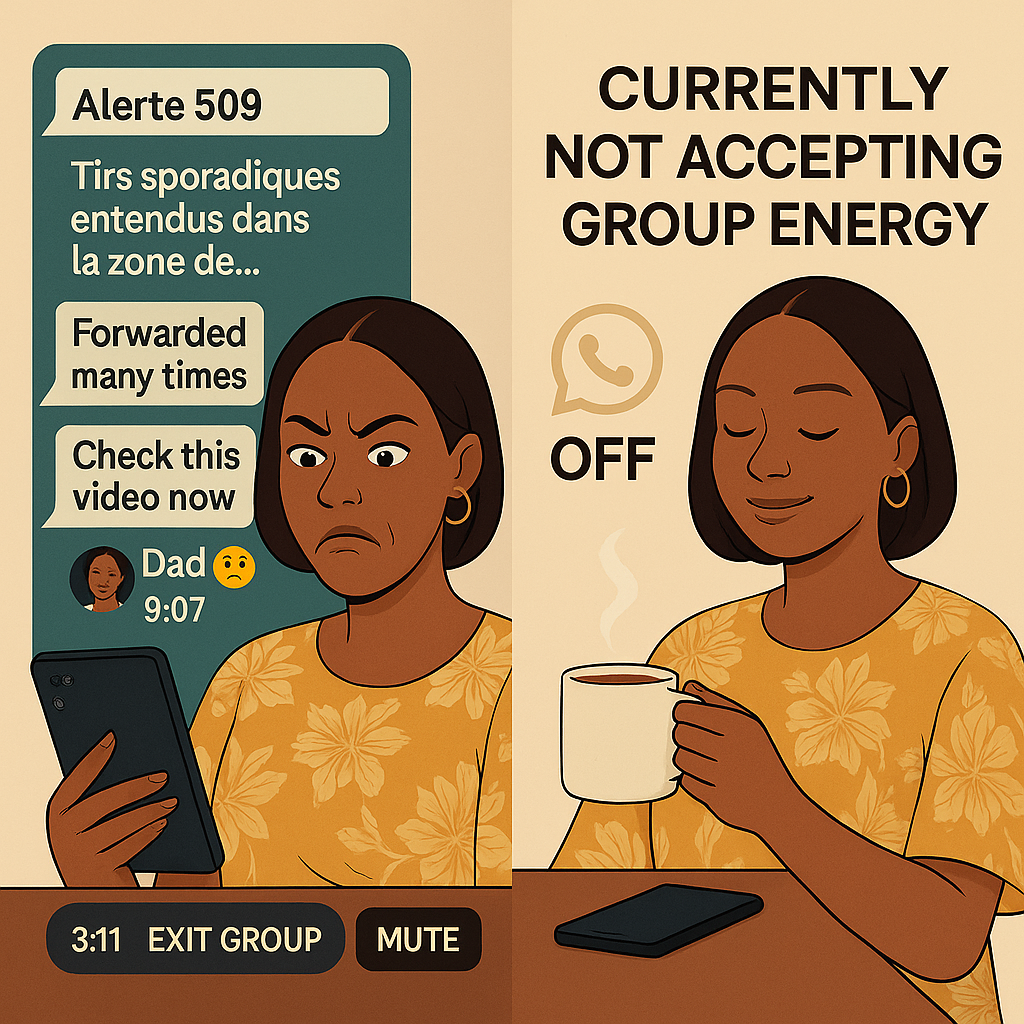
I hate group chats.
My people know not to randomly add me to one unless they’re prepared for me to leave just as fast. That said, I do recognize how useful they can be—I’m also the first to create one if we’re planning a group trip or brunch or a bachelorette weekend. But I’m firmly in the camp that believes once a group chat has served its purpose, it should quietly be laid to rest. No lingering. No repurposing. No “keeping it for future plans.” Let it go. Exit gracefully. Delete with intention.
For a long time, I successfully avoided group chat drama. My work-related groups live on my work phone, which helps me compartmentalize (bless that boundary), and outside of that, I’ve only ever had a couple of groups with my two core friend circles.
But over time, WhatsApp evolved into something much more chaotic. In Haiti, WhatsApp has become the main hub for information. Articles? You no longer need to search official news websites. Someone will send a link at 6 a.m.—and not just one. YouTubers, self-proclaimed analysts, bloggers, journalists, or just someone with Wi-Fi, a mic and a strong opinion—they all land in the same digital soup, circulating through groups and channels like wildfire.
I think it really started around 2019, during the height of the Peyi Lòk episodes. That’s when even my group-chat-averse self agreed to join some “info-only” groups. At first, it was genuinely helpful—updates on gas shortages, protest routes, roadblocks, missing persons. But then came the misinformation. The propaganda. The unsolicited and deeply disturbing images. Footage of bodies. Graphic violence. Criminals showing off their crimes. Some admins tried to keep order, but it was a losing battle. The chaos crept in anyway.
And here’s the thing—while staying informed is part of my job, drowning in a sea of trauma isn’t. I had to draw the line. I had to choose which groups to stay in and which to leave. Waking up from a 30-minute nap to 200 unread messages? That’s not “staying informed”—that’s psychological warfare.
Too much information, especially when unverified or graphic, is just not good for your mental health. Eventually, you have to curate. Do a little triage. Pick your sources. You don’t need to be in every news-sharing group. And, please, you don’t need to forward every single thing you see. Especially if it includes images of dead bodies.
And don’t get me started on the voice notes. The five-minute “just checking in” messages? The long, rambling, fear-inducing voice notes ? Headache. Pure headache. I mean, I love you, Dad—but that 9-minute voice note you sent to the neighborhood group chat? Yeah… it wasn’t giving what it was supposed to give.
I can’t leave every group, unfortunately, but I’ve learned to stick with the ones that are well-administered. Others? I shifted some to my work phone—so on my days off, I can truly unplug.
And since we’re talking about WhatsApp, let’s normalize taking control of our whole experience there. I disabled my “last seen” ages ago—not because I’m afraid of being called out for leaving someone on read (because honestly, I wish a B would), but for my own peace. I’ve known the stress of watching those little check marks and wondering why someone hasn’t replied to my slightly risky message. So the second they gave us the option to turn off read receipts? I grabbed it and never looked back.
I don’t want to know who saw my status. I don’t need to know whether you read my message and replied immediately, or took two hours to send a two-word response. The mystery is better for my blood pressure.
And for my most dramatic boundary-setting moves: sometimes I archive chats, turn off notifications, disable WhatsApp’s ability to use my mobile data, or just delete the app altogether. And yes—it’s liberating. Right up until your family abroad needs to check in on your well-being (or send you those good morning memes) and now you’re re-downloading the app mid-silent-recovery. Sigh.
 Thriving Through the Thirties
Leave a comment